It Renames the Queue
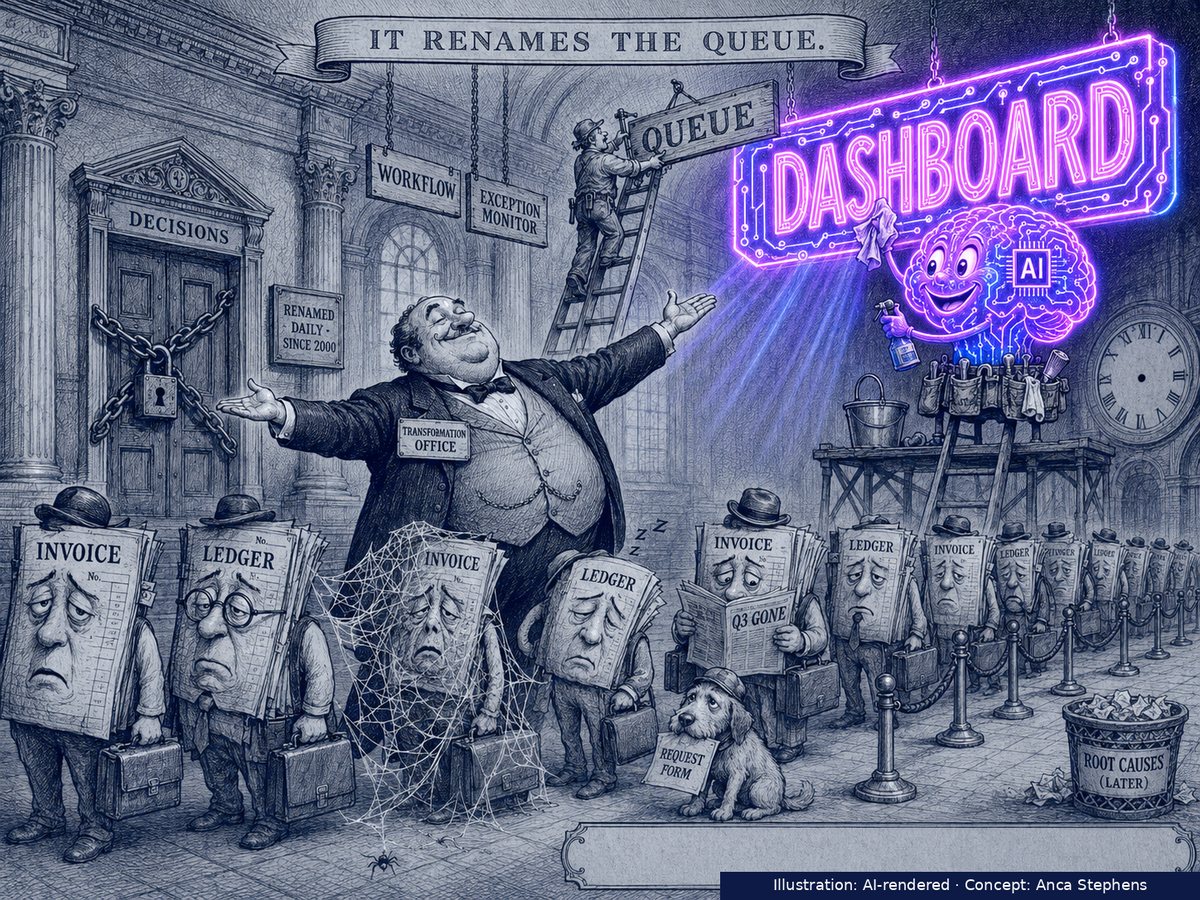
The anatomy of automated waiting across the Order-to-Cash cycle, and the test that exposes it.
I. The shorter queue that was not shorter
Automation has one honest limitation and one dishonest habit. The honest limitation: it can only execute decisions that have already been designed. The dishonest habit: where the decision was never designed, it relabels the waiting and calls it progress.
The follow-up becomes a workflow. The ticket becomes an exception. The waiting becomes a dashboard. A dashboard is a queue with better lighting.
When decision rights stay untouched, automation does not remove work. It renames it. I have watched this pattern survive three generations of ERP systems, because the renamed queue photographs well in a steering committee.
II. The anatomy: eight stations, one disguise
Walk the full Order-to-Cash cycle and the queue is never called a queue. It compiles at every station, wearing a professional name at each one.
Customer and contract foundation. Three master records for one customer becomes a “data cleansing initiative”. The waiting decision: which record is the truth, and who is allowed to change it. Next door, rebate conditions from two price lists ago keep calculating, renamed “contract maintenance backlog”. Nobody re-decided the terms; the system just kept obeying the old ones.
Order management and fulfillment. Failed order validations become the “exception monitor”. Scarce stock becomes a “prioritization list”, where the real decision, which customer matters more, is made by whoever runs the allocation report first. Export control holds become “compliance checks pending”, aging quietly while the shipment waits for a decision nobody owns.
Billing and invoicing. Unissued invoices become the “billing due list”. Manual tax reviews park revenue behind a determination error flagged months ago. Credit notes queue for an approval step that has not changed an outcome in years, it exists because it always existed.
Accounts receivable and collections. Money already paid becomes “unapplied cash”, homeless because two systems disagree on a reference. Disputes without a reason code become “open items”, unable to move because nobody named which function must act. Dunning escalations loop as “workflow stages”, reminders imitating a conversation no one is having.
Credit and risk governance. The credit limit review becomes the “periodic review backlog”: scheduled, performed, almost never re-decided. Order blocks lifted ad hoc teach Sales that blocks are negotiable and teach the system nothing. Exposure alerts fire until they get renamed “noise”, the most dangerous renaming on this list.
Process, data and automation. Interface errors compile in monitors that someone repairs record by record, daily, for years: the decision to fix the mapping once was never taken. And the newest disguise: a bot that automates a broken step is not improvement. It is renaming at machine speed.
Reporting and KPIs. Report requests compile into a “reporting backlog” measuring what is extractable rather than what is decidable. Audit findings that reappear every year are not findings anymore. They are a queue of accepted risks with an annual reprint.
Governance and improvement. Root-cause analyses that stop at the symptom. Improvement ideas moved to the “parking lot” slide, and the parking lot is a queue with a friendlier name. New joiners learning the workaround before the policy, because the workaround is what actually works.
Eight stations, dozens of respectable names, one identical object underneath: an Unmade Decision with an owner and a daily price. Automation applied on top of this anatomy does what it is asked. It processes the disguise.
III. Age tells you the cash is late. The reason tells you what is stuck.
Aging is the loudest report in receivables and the least useful one alone. A 90-day bucket says cash is waiting. It cannot say why, and “why” is where the decision lives. Every dispute belongs to one of four families: credit, billing, delivery, or data. Code by reason and the queue confesses. In one industrial portfolio, a wall of “late payments” turned out to be delivery documentation the customer could not match. Recoded, the escalation moved from finance to logistics, and a dispute cycle aging for months resolved in weeks. Nothing was automated. Something was named.
The cash flow statement shows the symptom months later. AR aging by dispute reason shows it in week one.
IV. The Monday morning test
A thinking partner I value, Phillip Larsen, asks the audit question better than any framework: how many items in our backlog would we no longer approve today? Three indicators answer it, no software required: override frequency, how often people work around the rule; deferral count, how many times an item was touched and re-parked; value decay, what the waiting has already cost. Any CFO can run this on Monday with the reports already in the building.
V. The numbers say the renaming is winning
The EU Payment Observatory’s 2025 report puts the average EU B2B invoice at 60.3 days to payment, with companies spending 9.85 hours weekly chasing money already earned; 31% of European SMEs say late payments threaten survival. Atradius finds 47% of Western European B2B invoices overdue, with bad debts at 6%. PwC’s Working Capital Study 25/26, analyzing more than 17,000 listed companies, shows global DSO up 5.7% over the past decade, from 47.3 to 50.0 days, and rising 8% since 2015 in the most cash-intensive sectors, while EUR 1.84 trillion of excess working capital sits trapped on balance sheets.
Read those numbers together and one conclusion is hard to escape: after two decades of tooling, the direction of travel is still backwards. The tools are not failing. They are faithfully executing renamed queues.
VI. Deleting: rebuild the Decision, not the tasks
What deleted hours in my own work was never speed. It was rebuilding the Decision the queue was hiding. I built a working prototype to prove it, in three layers: a ranking layer orders the portfolio by one criterion, where a decision changes cash today; an explanation layer translates evidence into CFO language; an execution layer routes, escalates, proposes the payment plan. Underneath all three, the quietest mechanism matters most: every analyst override taught the ranking what good looks like. The corrections became the logic. That stream deserves its own article, and it gets one next week.
Modelled on a 25-account portfolio, a 200-hour monthly cycle became 40. About 80% of manual effort retired, not renamed, roughly EUR 336K per year modelled for a team of seven. The hours did not get faster. Most of them stopped deserving to exist.
VII. Renaming is survival. Deleting is leadership.
Renaming is what queues do to survive: it keeps the waiting employed. Deleting is a leadership act, because deleting moves decision rights, and decision rights only move when someone senior signs.
Organizational Silence settled into queues. The queues got renamed, at every station of the cycle. The remaining question is what those queues were quietly worth all along, the corrections, workarounds and hard-won judgment that flowed through them for decades.
That answer has a name already. It arrives next week.
Sources: EU Payment Observatory, Annual Report 2025 · Atradius Payment Practices Barometer, Western Europe 2025 · PwC Working Capital Study 25/26 · Morrison & Milliken, Academy of Management Review, 2000 · Illustration: AI-rendered, concept Anca Stephens