The Engine: Why I Built It
For 20 years, I watched the same scene repeat itself.
Eight in the morning. A credit analyst sitting in front of three open screens: the ERP, an Excel file, a financial portal and a notebook on his desk. Searching. Copying. Calculating. Interpreting.
By the time the analysis is ready, half the day is gone.
By the time a decision is made, the customer has already missed another payment.
I lost count of how many times I sat next to people who knew exactly what to do, and could not get there fast enough.
That feeling never left me.
Last year, I decided to do something about it. Not to write another framework. Not to deliver another training. To build.
I started from a belief that goes against most of what the industry still teaches: collection does not start when an invoice becomes overdue. It starts much earlier. With the first lead. With how a customer is selected, onboarded, understood, monitored.
By the time someone is late paying you, the story has already been written. The Engine I built tries to read that story earlier.
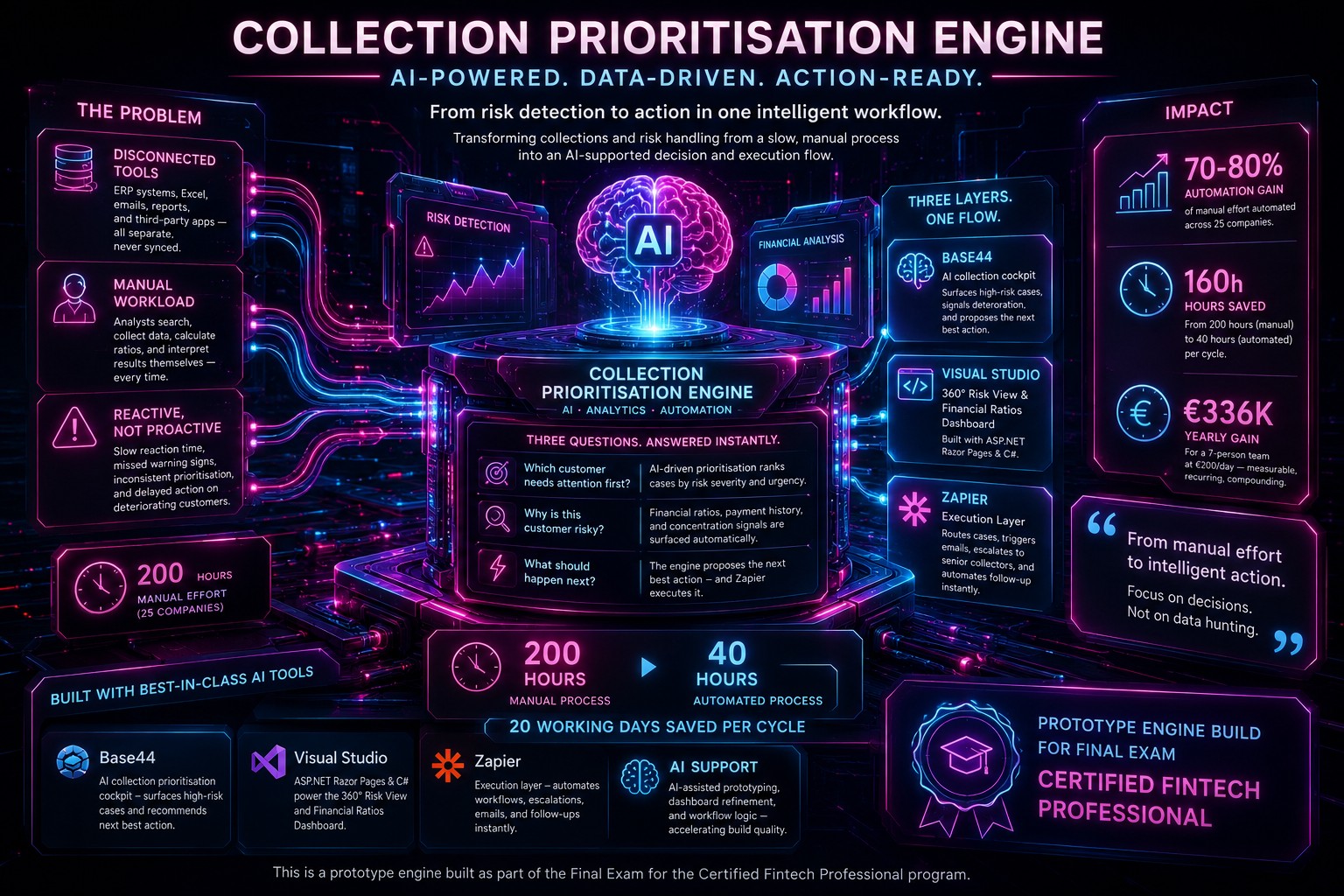
Three layers, one flow.
The first layer surfaces the risk: which customer needs attention, and why.
The second layer turns the evidence into something a human can actually use: a 360° view, financial ratios in plain language, a clear next step.
The third layer takes the action: routes the case, sends the email, escalates if needed, frees the senior collector to do what only a senior collector can do.
In the prototype, a single cycle dropped from around 200 manual hours to around 40. For a team of seven, the model showed an indicative annual gain of around €336,000.
But the number is not what moved me.
What moved me is that I had finally built something that protected the people doing the work. The senior judgment I spent years developing in others was no longer drowning in compiling. It could finally go where it mattered.
That, for me, was the real win.
I am still learning. The Engine is a prototype, built on publicly available data, designed to prove a point, not to sell a product. But the point is proven.
The work of credit and collections in 2026 does not need more tools. It needs a connected way to read what the business already knows.
If you lead a credit or O2C team, I would love to hear what part of your day still feels like 2010. That is usually where the next opportunity is hiding.