AI vs. Credit Scorecards: Neither Is Universally Better
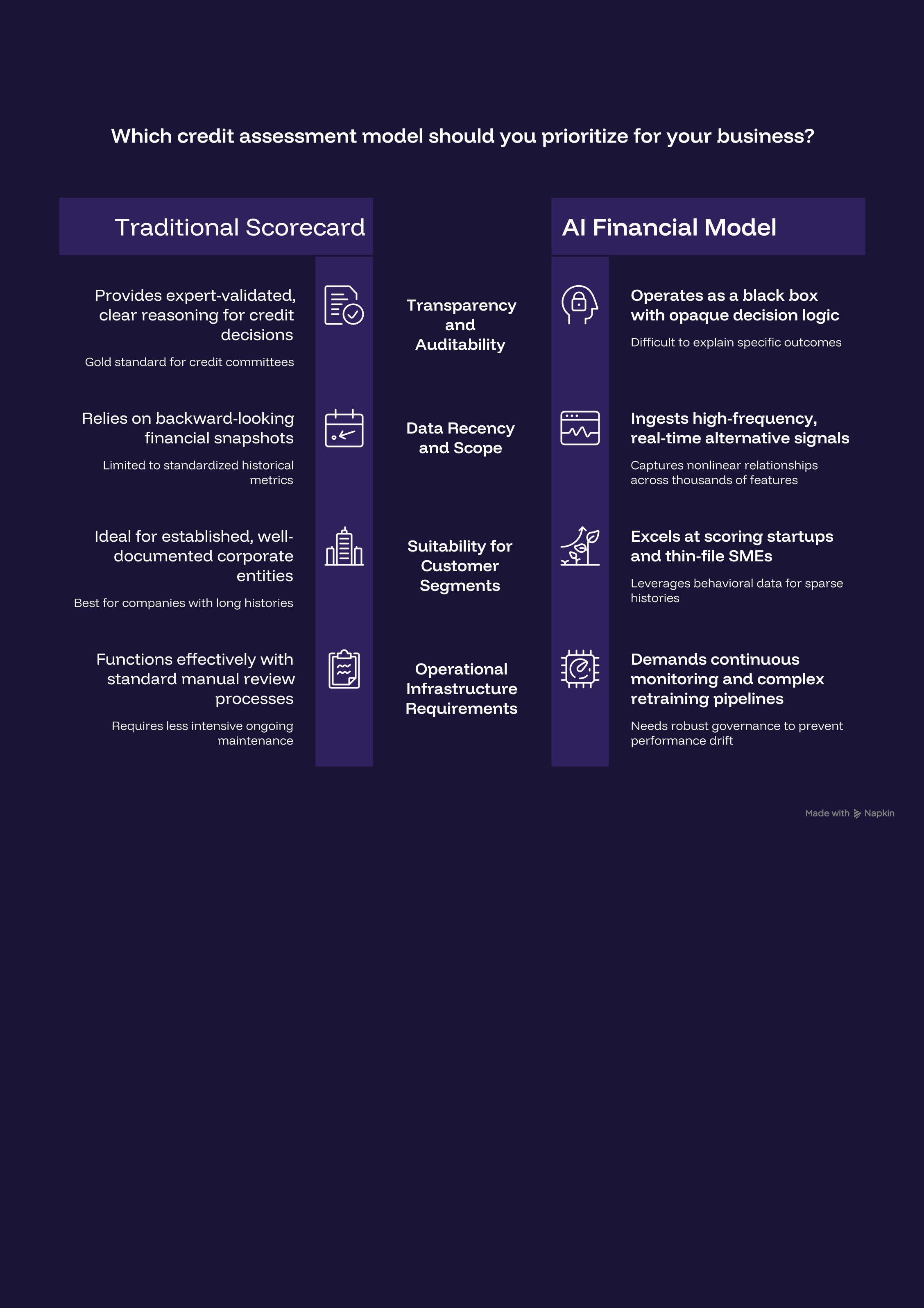
Everyone's arguing about whether AI will replace business credit scorecards.
Traditional scorecards on one side, AI-based financial-health models on the other. The only firm conclusion I'll stand behind: neither is universally better.
A mature traditional scorecard does a few things very well:
It estimates a company's probability of default over a defined horizon, usually 12 months, on a standardized, comparable scale.
It draws on financial soundness, profitability, solvency and payment behaviour, often with the provider's own claims experience and sometimes country or sector overlays.
It's transparent, expert-validated and auditable. For a lot of credit committees, still the gold standard.
The catch: it's a snapshot. Only as current as the data feeding it, and most of those signals are backward-looking.
AI/ML models flip several of those weaknesses:
They ingest alternative, high-frequency signals (news, court filings, web traffic, supply-chain movements) close to real time.
They pick up nonlinear relationships a traditional model won't see.
They can score thin-file companies, startups and SMEs with sparse history, using behavioural and contextual data.
They scale across thousands of features and markets without manual recalibration.
The cost: black-box risk. The model hands you a score and often can't tell you why. Performance can drift quietly without monitoring. And in many jurisdictions, the regulatory framework for AI in commercial credit still isn't there.
So which one do you run? It comes down to your context:
Governance. If your credit committee and regulators want full transparency and reason codes, the scorecard stays your foundation. AI supplements, it doesn't replace.
Customer base. Established corporates? Scorecards hold up. Startups, thin-file SMEs, emerging-market names? That's where AI and alternative data earn their keep.
Risk appetite and infrastructure. AI needs continuous monitoring, retraining and real governance. Without those, a well-maintained scorecard beats a badly governed ML model every time.
One case stuck with me. Order release was bottlenecked on the traditional model alone: every borderline case needed manual sign-off from people who weren't always available. The stuck orders were standard shipments above €100K, exactly the high-volume business you want moving fast, not sitting still. We added an AI overlay to clear the straightforward cases and flag only genuine exceptions. Release time went from one day to one hour.
That's the pattern: run the scorecard as the primary decision engine, the 12-month PD on a validated scale, and layer AI on top as a challenger and early-warning overlay that clears the easy traffic before anyone touches it.
AI was never going to replace the scorecard. The real skill is KNOWING which tool to reach for, when, and Having the INFRASTRUCTURE to run both well.
Visual: AI-generated.