Return on Corrections (RoCor)
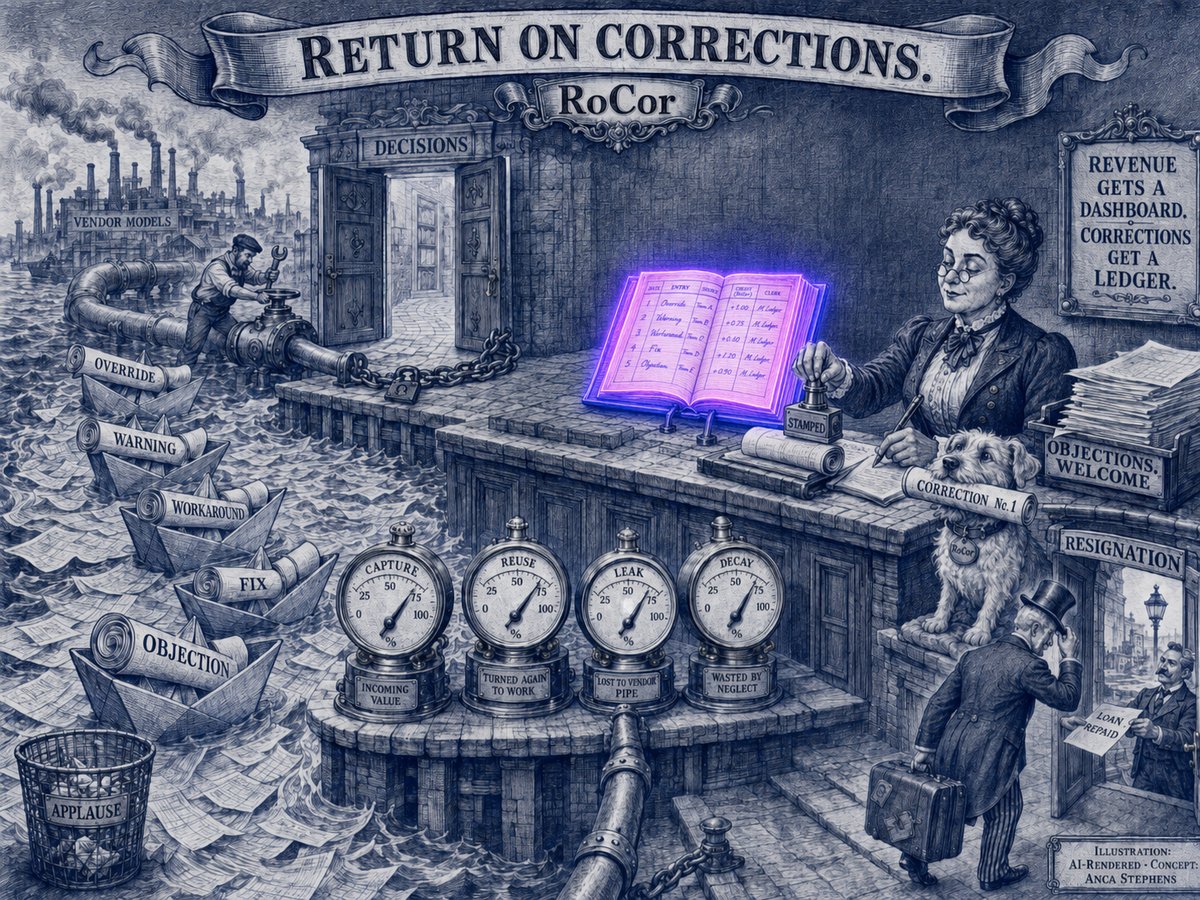
The metric for what your organization learns and loses every day. A metric in development.
I. Two paradoxes, one invoice
In 1962, the economist Kenneth Arrow described a paradox in the market for information: a buyer cannot know the value of information without seeing it, and once seen, it has been acquired without payment. The seller was the vulnerable one.
On July 12, 2026, Satya Nadella turned the paradox around. In the age of AI, he argued, it is the buyer who leaks: to make the models useful, enterprises must expose their proprietary knowledge, and the models learn from the exhaust, the prompts, the traces, and above all the corrections people make when the machine is wrong. He called it the Reverse Information Paradox. You pay for AI twice, and the second payment is invisible.
Both paradoxes are true. Both are also younger than the problem.
II. The leak had a payroll
Long before models, organizations ran on corrections nobody recorded. The expert fixed the system, the system took the credit, and the knowledge walked out with the next migration or resignation. Every override of a rule that no longer fit reality, every workaround that kept an order moving, every warning spoken in a meeting: that was the intelligence the organization actually ran on. Almost none of it was ever written down.
It did not disappear. It settled into silence, and silence settled into queues. The disease has a documented name, Organizational Silence, and a birth year, 2000. AI did not create the leak. It priced it.
And that is the phenomenal part: what gets priced can finally be owned.
III. The unicorn at one desk
I learned what an uncounted correction is worth on a project I will keep deliberately vague. The idea was beautiful on the slide: one centralized Order-to-Cash headquarters for dozens of sites spread across continents, time zones, system landscapes old and new, Excel and paper included, different languages, different legal regimes. The idea was also a unicorn, and I was the one person carrying the knowledge to see it.
Speaking up was not punished there. It was performed over. The warnings were spoken, minuted, and the plan proceeded unchanged, because the design lived in a parallel reality where the flows required no time zones, no access rights, no resources, and no scope in the meetings. Every warning I raised was a correction to the design. None of them was counted. The project cracked exactly along the lines the corrections had drawn in advance.
That is the part the post-mortems never wrote down: the failure was fully documented before it happened, in corrections nobody recorded as an asset. The knowledge existed. The ledger did not.
IV. The correction stream becomes logic
Years later I built a working prototype to test the opposite approach: what happens when corrections are treated as the most valuable data in the room.
The Collection Prioritisation Engine ranks a receivables portfolio by one criterion: where a decision changes cash today. Its quietest mechanism matters most: every analyst override taught the ranking what good looks like. A correction was not friction. It was training, owned by the team that produced it. Modelled on a 25-account portfolio, one monthly review cycle went from 200 hours to 40. About 80% of manual effort retired, not renamed, roughly EUR 336K per year modelled for a team of seven. The hours did not get faster. The corrections stopped evaporating.
V. The metric: RoCor, and how to calculate it
Return on Corrections measures how much of its own correction stream an organization keeps, and what that stream earns. The headline number is a return ratio any CFO will recognize:
The numerator is not mystical. Every reused correction has a price tag that already exists somewhere in your books: the dispute that did not recur (its handling cost is known), the write-off that did not happen (its amount is known), the hours a process stopped consuming (my Engine's 160 hours per month had a payroll value), the audit finding that did not reappear (its remediation cost is in last year's actuals). The denominator is the cost of the ledger itself: the minutes to record a correction with a name, a reason and an outcome, plus the system that stores and routes it. In my modelled prototype, the ratio was embarrassing in the metric's favor: capture cost a few minutes per override; the retired cycle hours alone repaid it hundreds of times over.
Underneath the headline sit four rates, one CFO page:
- Capture rate: corrections recorded as reusable logic / corrections occurring. An unrecorded correction is a donation.
- Reuse rate: repeat incidents prevented / captured corrections. A dispute that returns monthly was never resolved, it was rescheduled.
- Leak rate: corrections flowing into vendor models, consultants' decks and departing heads with no documented ownership. This is Nadella's invoice, made visible.
- Decay rate: captured knowledge that dies of staleness or walks out the door. Knowledge held in one head is not an asset. It is a loan, repayable on resignation day.
And for the Monday-morning version, no software required: count three things for one month, override frequency, deferral count, and recurrence per dispute reason. Those three proxies are the metric's pulse. Revenue gets a dashboard, corrections get a shrug: RoCor exists to end that asymmetry. A warning is noise until it carries a number.
The science behind the metric is older than the metric. In 2005, van Dyck, Frese, Baer and Sonnentag published a two-study replication in the Journal of Applied Psychology: across 65 Dutch and 47 German organizations, error management culture, communicating about errors, detecting, analyzing and correcting them quickly, was significantly related to firm performance. The German study set a demanding test: a hierarchical regression on return on assets controlling for firm size, industry sector and the previous year's return on assets, in which error management culture still explained a significant share of the change (β = .27, p < .05; for goal achievement β = .58, p < .01). The authors are careful about what this does not show: an association with objective performance, not the mechanism behind it. The culture was proven. The instrument was never built. RoCor is my attempt at that instrument. Honesty requires the boundary: it is a management lens in development, not an audited standard. That is how every metric began, including the ones your auditors now insist on.
VI. What the metric sees that dashboards do not
In two weeks of public conversation, the same lens exposed four rooms. Governance: policies do not break, they drift, and the correction stream measured against written policy shows the distance between paper and practice, continuously. Culture: finance teams do not choose silence, they learn it; finance stops being silent the day its corrections start counting. Continuity: the one-person dependency every CFO fears is the decay rate wearing a personnel file. Incentives: experienced people are not obstructing AI adoption, they are pricing it; nobody deposits into an account that shows no balance. Give the learning loop a ledger and the deposits begin.
One field test, run recently on a well-built SaaS vendor's public website: three demo requests, same person, three self-declared company sizes, three different automated outcomes, and not one contradiction recorded anywhere. An unverified field steering an automated decision, with no exception trail. The same anatomy sits inside every O2C cycle: a VAT number typed once at onboarding steers every automatic tax determination after it. Automation standing on declared fields produces confident mistakes at machine speed, and nobody is counting the corrections that could have caught them.
VII. The trilogy closes
The queue is where organizations store their unmade decisions. Automation, without a rebuilt Decision, renames the queue instead of deleting it. And the correction stream that flowed through those queues for decades is where organizations store their unclaimed capital.
Arrow showed the seller could not protect information. Nadella showed the buyer cannot either. Practitioners knew the third truth all along: the people who correct the system every day were never in either seat, and their knowledge was always the real asset. It was simply never on any balance sheet.
RoCor is my proposal for putting it there. Named in public, grown in public, corrected in public, exactly as a correction stream should be.
Open questions, honestly held. How do we value PREVENTED events with counterfactual discipline, beyond before-and-after recurrence? Can leak rate be observed at the vendor boundary at all, or only inferred? Are all corrections equal, or do they need severity weighting? And the one that worries me most: the moment corrections are credited, does Goodhart arrive, people manufacturing corrections to farm the metric? Culture researchers have measured silence and voice for decades; perhaps what this needs is their rigor married to a balance-sheet language. If your discipline touches any of these, organizational psychology, information economics, audit, AI procurement, I want the objection more than the applause.
Sources: Arrow (1962) · Morrison & Milliken (2000) · van Dyck, Frese, Baer & Sonnentag (2005) · Nadella (2026) · Illustration: AI-rendered, concept Anca Stephens